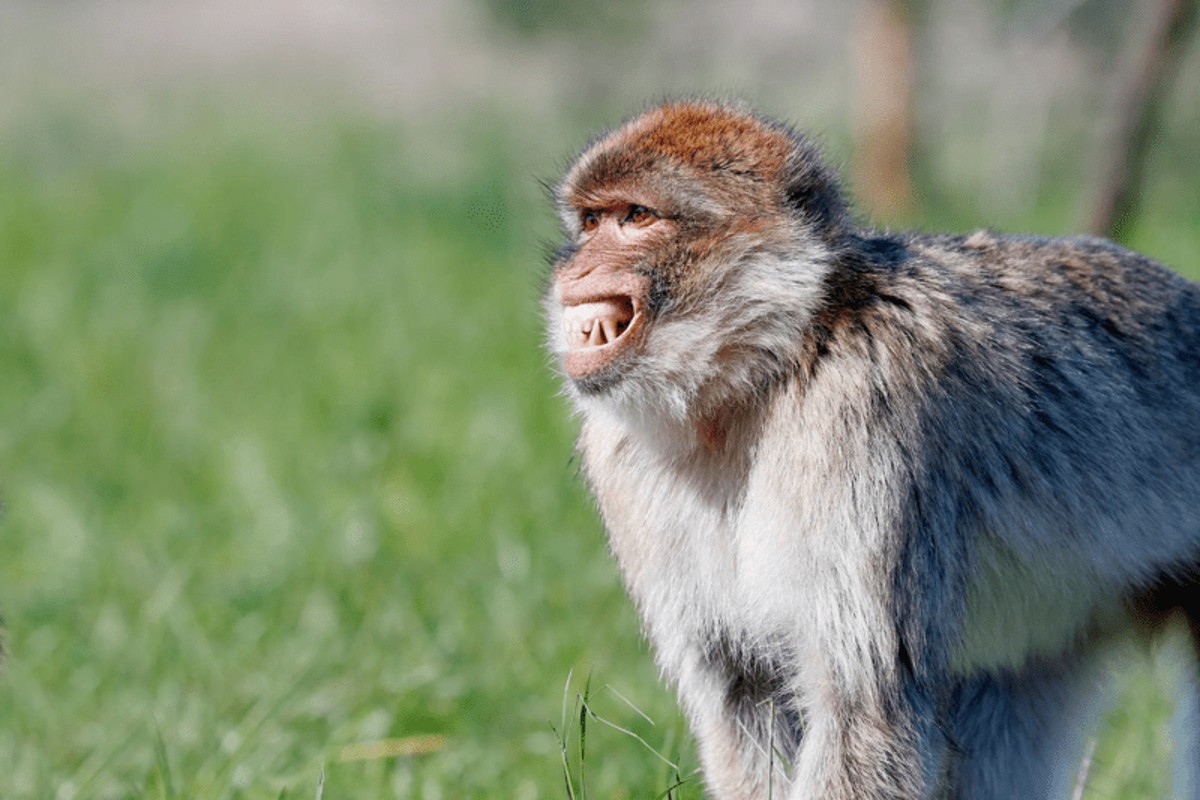
New research suggests that monkeys, like humans, don’t simply display emotions on their faces—they choose them, blending involuntary reactions with deliberate social signaling. A study published in Science demonstrates that both the emotional and voluntary control centers of the macaque brain work together to produce facial expressions, challenging decades-old assumptions about how faces reveal true feelings.
The Old Theory vs. Reality
For years, the dominant idea was that facial expressions are largely automatic, a direct output of internal emotions. This view struggles to explain why we fake smiles, suppress reactions, or carefully adjust our expressions to fit social situations. The new research suggests that the brain doesn’t just react —it calculates.
How the Study Works
Researchers at the University of Pennsylvania and Rockefeller University monitored neural activity in rhesus macaques as they interacted with each other, digital avatars, and videos of other monkeys. Their findings showed that both the medial cortex (responsible for spontaneous emotions) and the lateral cortex (controlling voluntary actions) are involved in all types of facial expressions.
This means that even seemingly “natural” expressions are partly a conscious choice, not just a gut reaction.
Speed and Timing Matter
The two brain regions operate at different speeds. The lateral cortex coordinates fast movements for smooth social interaction, while the medial cortex processes slower-changing factors, like assessing dominance hierarchies (“Is the alpha male still threatening me?”). Importantly, neural patterns precede facial movements, indicating that the brain prepares expressions in advance.
Are Monkeys Manipulative?
Researchers at Nottingham Trent University argue that if facial expressions are partly voluntary, they may be “tools for social influence.” This implies that macaques, like humans, use their faces strategically to manipulate others, rather than simply broadcasting honest emotions.
If true, this raises uncomfortable questions about the sincerity of all facial expressions.
The Bigger Picture
Social and evolutionary psychologist Alan Fridlund suggests that the study provides a more detailed way to investigate the neurology of facial displays. However, he cautions that lab settings may not fully capture the complexity of primate communication in the wild.
The findings suggest that faces are not just mirrors of emotion—they’re active participants in social games, blending instinct with intent.
This research doesn’t prove that monkeys deliberately plan every grimace or grin, but it does demonstrate that facial expressions are far more complex than previously believed. The study challenges the long-held assumption that faces always reveal what’s “inside” and suggests that we may be reading emotions into expressions that are, at least partly, constructed for social effect.