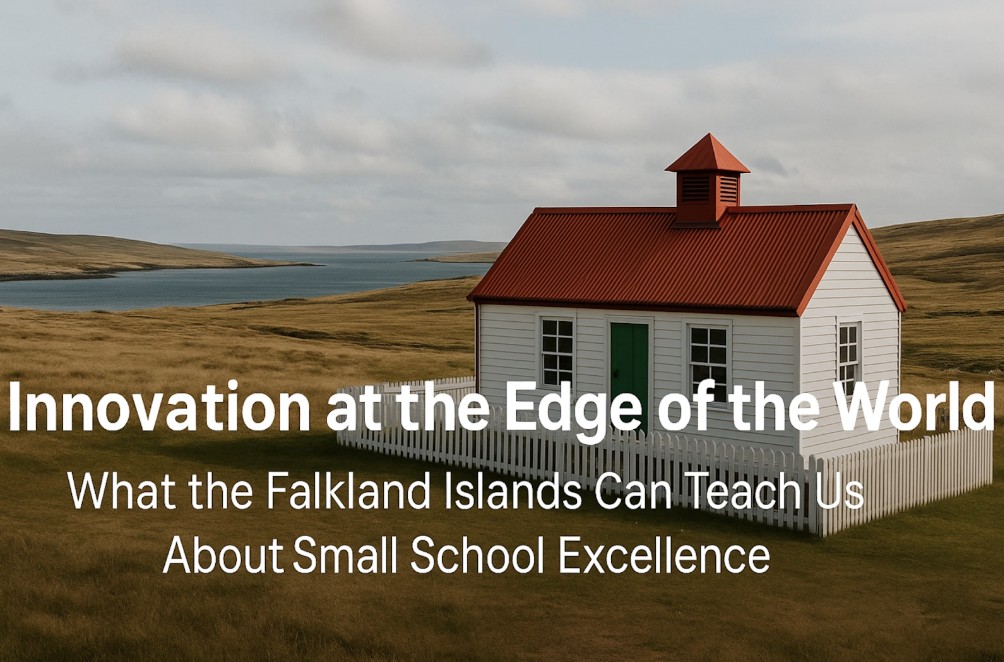
The most valuable insights in education often emerge from the most unexpected corners of the world. Recently, a journey 8,000 miles from California to Stanley, in the remote Falkland Islands, revealed a powerful lesson about small school effectiveness: true student-centered learning isn’t about offering every option under one roof, but ensuring each child has the right option, even if it requires unconventional approaches.
The Falkland Islands, a British Overseas Territory in the South Atlantic, exemplify this principle. With a tiny population scattered across rugged terrain, traditional schooling is impractical. Instead, they’ve built a system defined by flexibility and adaptation. One family’s experience illustrates this perfectly: their 11-year-old son boards at a district-provided residence during the week while their 9-year-old receives tailored lessons at home, blending traveling teachers, remote instruction, and technology.
The core message? Constraints breed creativity. The Falklands didn’t choose to innovate; they had to.
Geography as a Catalyst for Innovation
With just 3,400 people spread across an area similar in size to Connecticut, the Falkland Islands education system relies on diverse pathways: multiage classrooms in remote settlements, traveling teachers who embed themselves with farm families, distance learning via phone and internet, and even government-funded study abroad opportunities for high-achieving students.
This isn’t simply a workaround for isolation; it’s a deliberate design choice. As one parent put it, the system isn’t about separation, but expansion. While boarding or overseas study might not be feasible everywhere, the underlying principle is universal: sometimes, excellent education requires thinking beyond district boundaries. Could small districts create shared residential programs? Regional exchange initiatives? Targeted summer institutes?
The Falklands Mindset: Flexibility as Excellence
What sets the Falklands apart isn’t just the logistics, but the mindset. There’s no stigma attached to rural schooling or distance learning. Instead, the system views flexibility as a strength. This contrasts sharply with many American schools that apologize for combined classrooms or struggle to provide specialized instruction with limited resources. The Falklands prioritize bringing expert teaching to students, rather than expecting students to seek it out.
This approach translates to three key lessons for small schools:
- Embrace Multiage Learning: Rather than viewing it as a limitation, leverage it as an opportunity for mentorship and leadership development.
- Prioritize Teacher Expertise: Invest in highly qualified teachers who can deliver instruction in multiple modalities.
- Integrate Technology Strategically: Use technology to connect students to resources and relationships, not replace them.
Applying Falkland Insights to Small American Schools
The Falklands demonstrate that small systems don’t need to mimic larger ones to achieve excellence. Instead, they can thrive by treating constraints as design prompts.
This means shifting from…
- “We can’t offer everything” to “We offer exactly what our students need.”
- “Mixed grades are a compromise” to “Multiage builds community.”
- “We’re isolated” to “We’re connected differently.”
Practical steps for small school leaders include developing a clear learner profile, creating a one-page strategic plan with measurable priorities, investing in teacher leadership, and focusing on outcomes over inputs. The key? Strategic planning in small systems isn’t about lengthy documents; it’s about a shared plan that aligns routines, staffing, and technology around what truly matters.
Ruralness as a Feature, Not a Bug
In places like the Falklands, small and rural aren’t liabilities; they’re the design brief. The system isn’t simply adapting to constraints; it’s leveraging them. By prioritizing personalization, relationships, and community-specific strengths, the Falklands have created an educational model that larger systems can’t replicate.
The question isn’t whether small schools can compete with larger ones, but whether they can design experiences that are uniquely tailored to their students and communities.
Ultimately, the Falkland Islands remind us that small doesn’t mean limited; it means focused, flexible, and fundamentally human. In an increasingly complex world, this might be precisely the kind of innovation education needs.