What happens when you take one of the most daunting pillars of the English literary canon—Herman Melville’s Moby-Dick —and launch it into deep space?
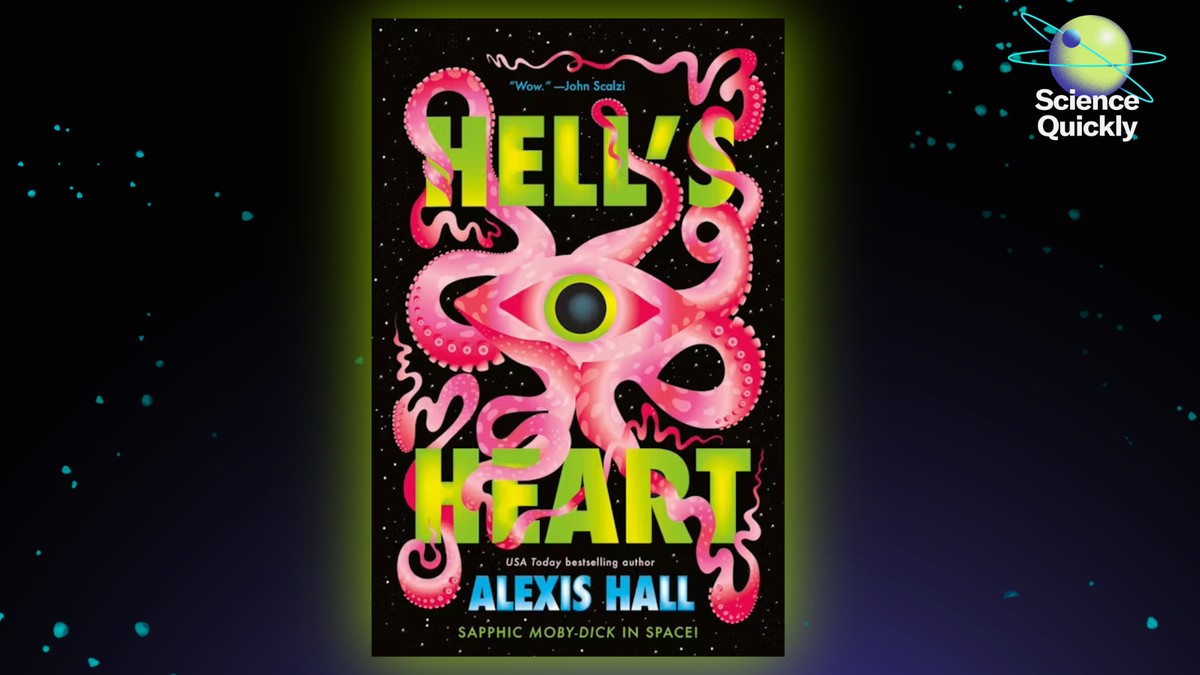
In her new novel, Hell’s Heart , author Alexis Hall performs a daring literary transplant. She transforms the 1851 tale of obsession and whaling into a “queer sci-fi space opera.” The result is a story that swaps the vast, unknowable oceans of Earth for the crushing, atmospheric depths of Jupiter, reimagining the classic Ishmael as a trans woman navigating a crew aboard the spacecraft Pequod.
From Whaling Ships to Starships
The inspiration for this cosmic shift was born from an unexpected source: a lockdown reading challenge. While attempting to read Moby-Dick one chapter a day during the 2020 pandemic, Hall found herself captivated not just by the plot, but by Melville’s granular, almost obsessive attention to detail.
“I think Melville is big enough to take it,” Hall notes. “I think part of the reason for picking science fiction specifically is there is a certain perspective from which Moby-Dick is a science-fiction book… The level of detail you have about how whaling works… is something you can still do in the science fiction genre.”
Hall argues that Melville’s fascination with the technicalities of whaling—even the bizarre or “random” biological details—mirrors the way science fiction builds worlds. By moving the setting to Jupiter, Hall is able to maintain that “energy” of hyper-specific, world-building detail while exploring a much more alien frontier.
The Science of the “Möbius Beast”
While the book is a work of fiction, Hall has infused it with a surprising amount of planetary science. The setting isn’t just a backdrop; it is a character in itself.
The novel explores the terrifying reality of Jupiter’s environment, incorporating:
– Atmospheric Composition: Hall researched the gases and temperature profiles of the gas giant to ensure the setting felt grounded.
– Extreme Phenomena: The narrative touches on real scientific theories, such as the possibility of “diamond rain” within Jupiter’s layers.
– Fluid Physics: The “hydrogen sea” at the center of the planet is inspired by the strange, mirrored behavior of liquid hydrogen and helium, known as superfluidity.
However, Hall is careful to manage reader expectations. She emphasizes that while she uses real science to pass the “sniff test,” the book is ultimately a space opera designed for narrative impact rather than a textbook.
A New Ecosystem: The Leviathans of Jupiter
To translate the maritime ecosystem of Melville’s work into space, Hall developed a complex classification system for the “titans” of Jupiter. These creatures serve both biological and narrative roles, filling the niches left by sharks, birds, and whales in the original text:
- Leviathans: The primary “whales” of the story, occupying the central role in the cosmic food chain.
- Wyrms: Eel-like creatures that serve the narrative purpose of sharks and scavenger birds.
- Krakens: Floating sacs that act as opportunistic predators.
- Behemoths: Large, sedentary creatures that, much like a whale carcass on the ocean floor, create a nexus for new life.
The Search for the Endless
Beyond the aliens and the physics, Hell’s Heart grapples with the core philosophical questions that made Moby-Dick a masterpiece. The original novel explored the “unknowability” of the ocean and the limits of human perception.
In Hall’s hands, this theme is updated for the space age. The “endlessness” of the Möbius strip—a recurring motif in the book—represents the endlessness of space exploration, the relentless hunt for resources, and the internal, infinite search for self-identity. By moving the setting to the stars, Hall makes the vastness of the unknown feel immediate and accessible to a modern audience.
Conclusion
Hell’s Heart is more than a mere retelling; it is a thematic evolution that uses the vastness of science fiction to explore the same timeless obsessions found in classic literature. Through a blend of queer identity and planetary science, it reimagines the “unknowable” for a new generation.