For decades, astrophysicists have grappled with a mathematical paradox: supermassive black holes are simply too large to exist according to our current understanding of physics. Under standard models, the process of “gas accretion”—where a black hole pulls in surrounding matter to grow—takes much longer than the age of the universe allows for these behemoths to reach their massive proportions.
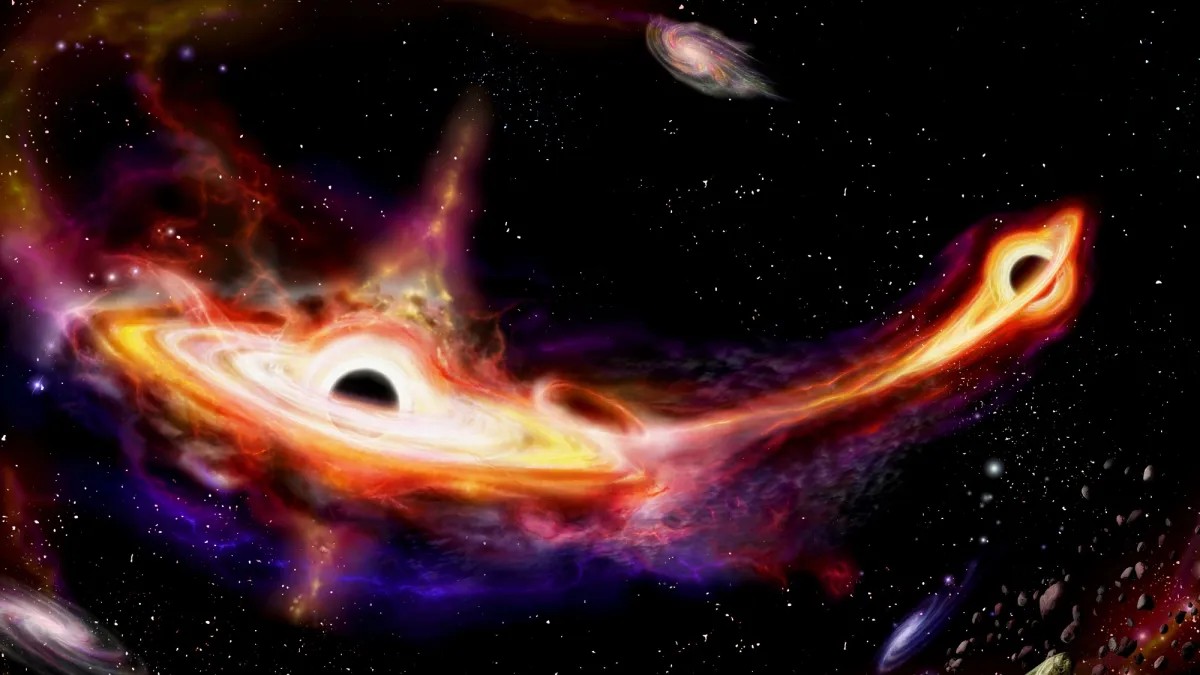
To solve this mystery, scientists have long proposed a “merger theory”: supermassive black holes grow by colliding with one another during galactic mergers. Now, a groundbreaking study offers the first direct evidence that this process is actually happening.
The Mystery of Markarian 501
The discovery centers on Markarian 501 (Mrk 501), an elliptical galaxy located in the Hercules constellation. Like many active galaxies, Mrk 501 possesses a powerful jet of supercharged particles being ejected from its center at nearly the speed of light. Because this jet is pointed directly toward Earth, it serves as a high-visibility beacon for astronomers.
Using radio frequency data collected over a massive 23-year observational period, researchers from Germany’s Max Planck Institute for Radio Astronomy noticed something impossible: the galaxy appeared to have two jets instead of one.
Tracking a Celestial Dance
The researchers didn’t just see a second jet; they watched it move. By analyzing the data, they observed a complex orbital dance:
- Orbital Motion: The second jet appeared to move counterclockwise around the first.
- Gravitational Lensing: In June 2022, the radiation from the second jet appeared distorted into a circular shape, known as an Einstein ring. This occurs when the gravity of the first black hole bends the light of the second, acting like a cosmic magnifying glass.
- The Orbital Period: Based on repeating cycles of brightness, astronomers estimate the two black holes orbit each other every 121 days.
“We searched for it for so long, and then it came as a complete surprise that we could not only see a second jet, but even track its movement,” noted study coauthor Silke Britzen.
A Massive Merger on the Horizon
While the distance between the two black holes—roughly 250 to 540 times the distance between the Earth and the Sun—might sound vast, it is incredibly tight on a cosmic scale. These objects possess masses ranging from 100 million to 1 billion times that of our Sun.
At this proximity, the two giants are on a collision course. Scientists estimate they could merge within the next century.
Why This Matters
This finding provides a crucial piece of the puzzle in understanding galactic evolution. If supermassive black holes grow primarily through these violent mergers rather than slow accretion, it changes our entire model of how galaxies form and mature.
While the actual merger will happen 440 million light-years away—far beyond the reach of direct human observation—the event will likely send ripples through spacetime. As they draw closer, the pair should emit extremely low-frequency gravitational waves, which future observatories may detect, providing definitive proof of this cosmic union.
Conclusion: The observation of dual jets in Markarian 501 provides compelling evidence that supermassive black holes grow through mergers, potentially solving a long-standing mathematical mystery regarding their immense size.