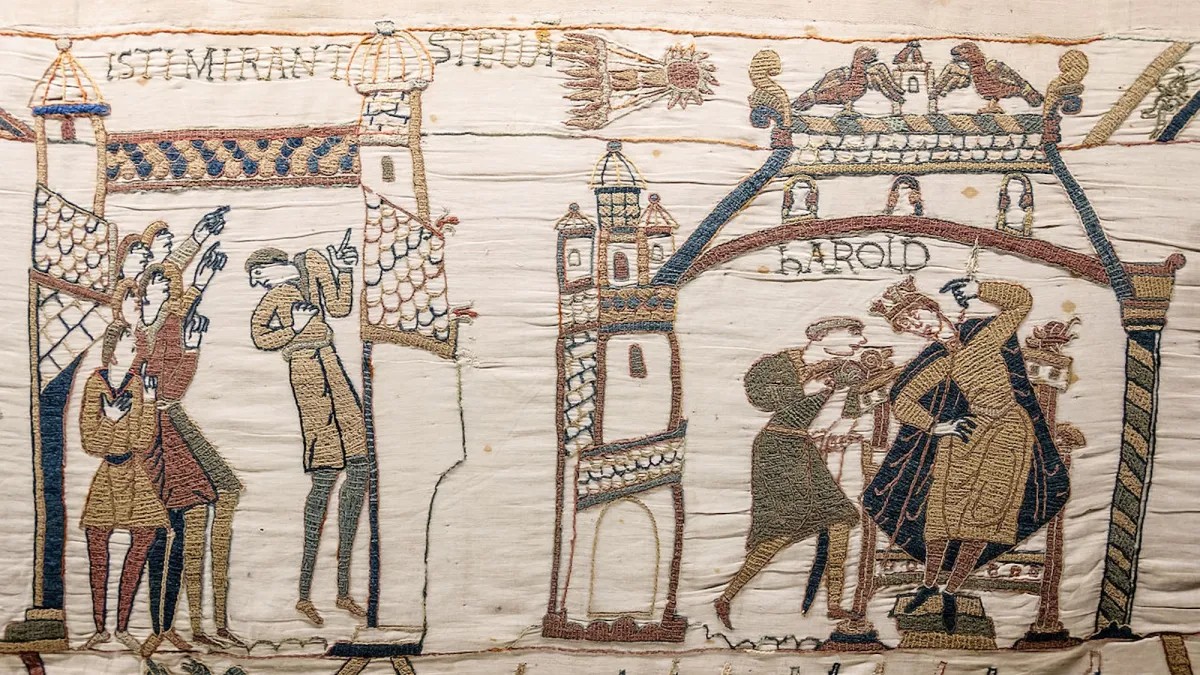
For centuries, the iconic comet has borne the name of Edmond Halley, the astronomer who first recognized its periodic orbit in 1705. However, new research suggests that an obscure 11th-century English monk, Aethelmaer of Malmesbury (also known as Eilmer), may deserve at least partial credit for identifying its recurring appearances.
The Historical Context: From Ancient Skies to Medieval Omens
Records of Halley’s comet stretch back over two millennia. Chinese astronomers noted its presence as early as 240 BCE, and Roman historians documented similar sightings in 12 BCE. These events were often interpreted as portents of disaster, a belief that persisted into the medieval period. The comet’s 1066 CE appearance coincided with William the Conqueror’s invasion of England, solidifying its reputation as a harbinger of change – or doom.
A Monk’s Observation: The Bayeux Tapestry and Beyond
The case for Aethelmaer rests on a unique observation. The monk reportedly recalled seeing the comet 76 years earlier, in 989 CE, suggesting an early awareness of its cyclical nature. This claim is supported by the writings of William of Malmesbury, a 12th-century chronicler, and subtly preserved within the imagery of the famous Bayeux Tapestry. The tapestry, which depicts the Battle of Hastings, indirectly references the comet as a bad omen for the defeated Anglo-Saxons.
Why Does This Matter?
The debate isn’t just about historical accuracy; it highlights how scientific discoveries often build on prior observations, even if those observations were made without modern tools or understanding. Aethelmaer’s recollection, though anecdotal, predates Halley’s formal calculations by centuries.
The Monk’s Legacy: A Cautionary Tale
Aethelmaer is also remembered for a rather… ambitious experiment in flight. Inspired by the myth of Daedalus, he constructed wings and jumped from a tower, breaking both his legs in the process. His friend William later quipped that the monk’s failure was due to forgetting a tail for stability. This eccentricity underscores the era’s mix of religious scholarship and reckless curiosity.
Ultimately, while Halley’s name remains firmly attached to the comet, the story of Aethelmaer serves as a reminder that even seemingly modern discoveries often have roots in the forgotten observations of the past.