Every year, hundreds of millions of birds embark on a massive journey to reach their northern breeding grounds. While these migrations often go unnoticed by the general public because they occur primarily at night, they are a critical ecological event. For bird enthusiasts and scientists, tracking these movements is essential—not just for observation, but for conservation.
The secret to monitoring this aerial traffic lies in an unexpected source: weather radar. The same systems that predict rain and storms are also capable of detecting the presence of birds in the atmosphere.
The Technology Behind the Tracking
Radar systems operate by sending out radio waves and measuring the energy reflected back to a receiver. This data reveals the distance and density of objects in the sky. While meteorologists use this technology to identify water droplets in storm clouds, ecologists have learned to repurpose it to quantify bird movements.
Kyle Horton, an ecologist at Purdue University and a member of BirdCast —a collaboration dedicated to tracking bird migration—explains the synergy between weather forecasting and ornithology. “If you turned on the Weather Channel… those are the same radars that we use as ecologists to quantify birds moving through the atmosphere,” Horton says.
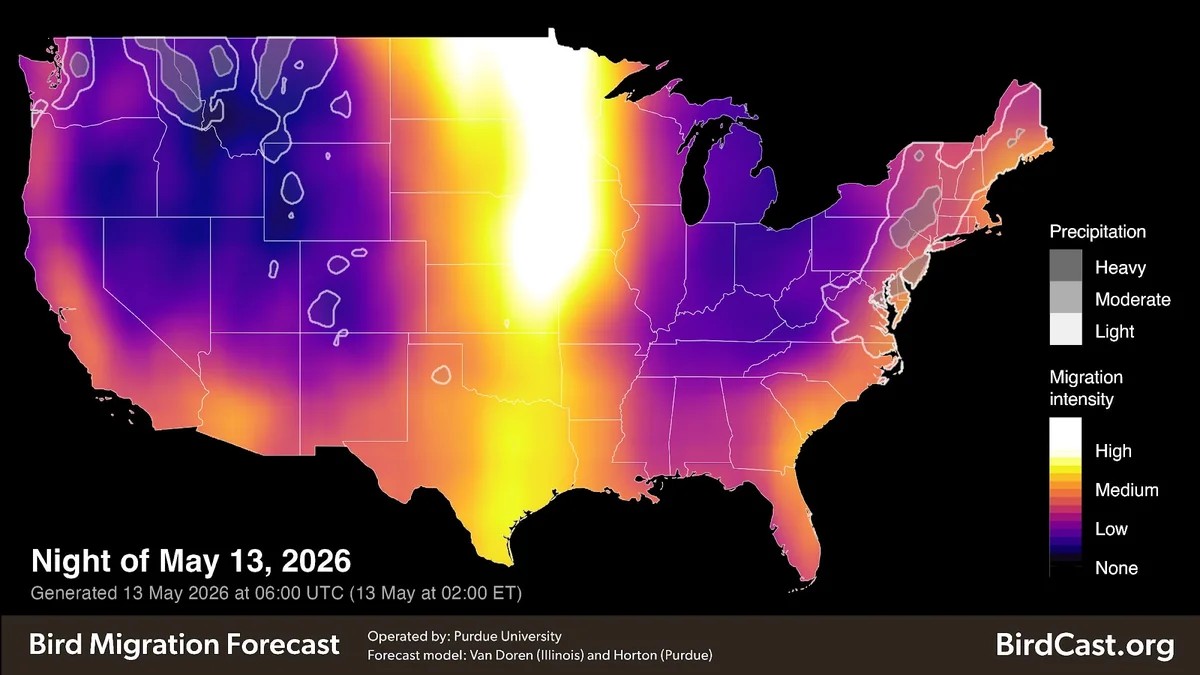
By processing this data, BirdCast generates real-time maps and forecasts that help birders understand how many birds are on the move and when they might arrive in specific areas.
Separating Birds from Storms
The primary challenge in using weather radar for ecology is data isolation. When a radar beam scans the sky, it picks up everything: rain, snow, insects, debris, smoke, and birds. Meteorologists need to remove biological clutter to see the weather; ecologists must do the exact opposite.
“We always like to say, ‘We just do the inverse of what meteorologists do,’” Horton notes. “They remove the birds to maintain the rain. We remove the rain to maintain the birds.”
Fortunately, birds and weather patterns leave distinct “signatures” on radar readouts, making them relatively easy to separate:
- Movement Patterns: Birds typically migrate along a north-south axis, while storms generally move from west to east.
- Structure and Density: Storms are dense, structured, and homogeneous. Birds, however, are dynamic. They flap their wings, fly in various orientations, and vary in size, creating a more complex and less uniform signal.
Filtering Out Other Flying Creatures
Beyond weather, ecologists must also filter out other animals that share the sky, particularly bats and insects.
Bats can be tricky to distinguish because some bird flocks exhibit similar behaviors. However, researchers look at the shape of the group. When bats emerge from a cave, they often form a doughnut-like pattern as they spread out to forage. Additionally, bats usually emerge from fixed locations (caves), whereas birds take off from a wide variety of spots across a landscape.
Insects are even more abundant but easier to filter out based on speed. Insects generally drift with the wind, whereas birds can fly significantly faster than the wind speed. Horton humorously refers to insects as “the detritus of the atmosphere” because their movement is largely passive compared to the active flight of birds.
The Limits of Radar Forecasts
Once the data is cleaned of weather, bats, and insects, the resulting maps can show the movement of up to 400 million birds during peak migration periods. These forecasts provide a powerful tool for understanding large-scale migratory trends.
However, radar has limitations. It cannot identify which species of birds are flying, nor can it tell you where the birds are resting during the day. A forecast might indicate a surge in activity, but that could mean birds are arriving in your area—or it could mean the birds you saw yesterday are departing.
“We don’t have a perfect science of it, and I think that’s what makes bird-watching fun,” Horton says.
Why This Matters
This technological intersection highlights a broader trend in environmental science: repurposing existing infrastructure for ecological monitoring. As climate change alters migration patterns, understanding these movements becomes crucial for conservation efforts.
While radar provides a macro-level view of bird traffic, it complements rather than replaces traditional birding. The uncertainty of not knowing exactly which species will appear adds to the allure of the hobby, even as science works to map the invisible highways of the sky.