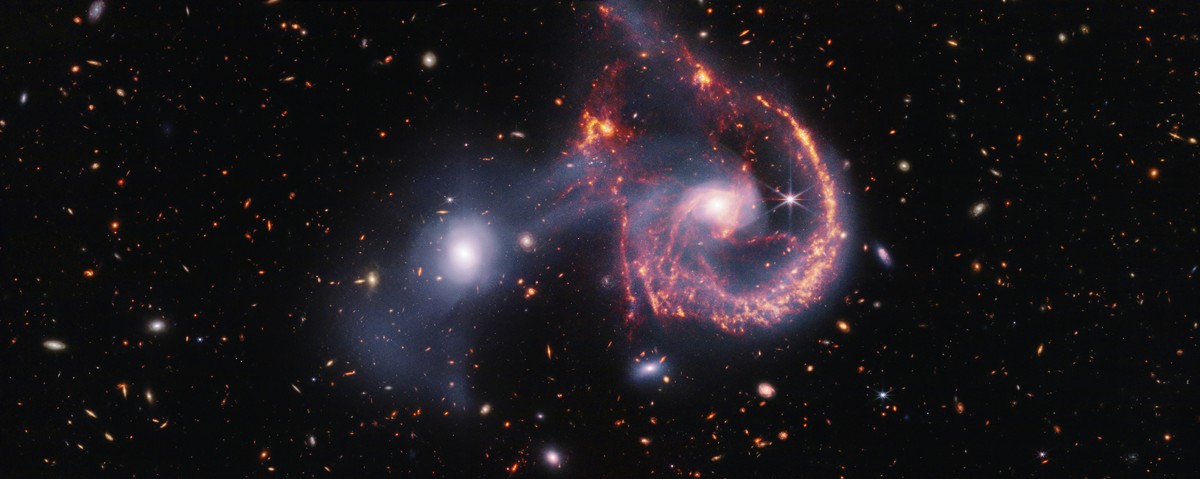
The expansion of the universe is one of the most counterintuitive ideas in modern cosmology. If space itself is stretching, how can galaxies still collide? This question often arises because it seems contradictory: shouldn’t everything be flying apart? The reality is more nuanced. Collisions happen because expansion dominates only on the largest scales, and gravity still exerts a powerful influence locally.
The Expanding Universe: A Misconception
The popular image of the universe expanding like an explosion—with galaxies moving through space—is misleading. The expansion isn’t about galaxies hurtling away from each other; it’s about space itself expanding. Imagine a flexible meterstick stretching from one to two meters. Points further apart move faster, while closer points move slower. This is precisely what happens in the universe: more distant galaxies recede faster, a phenomenon we can measure.
For example, a galaxy 10 megaparsecs (32.6 million light-years) away moves away at roughly 700 km/sec, while one megaparsec away moves at just 70 km/sec. Despite this rapid expansion, galaxies can still overcome it through sheer velocity.
Local Gravity Overrides Expansion
The Andromeda galaxy provides a clear example. Though 2.5 million light-years away, it isn’t receding. Instead, it’s barreling towards the Milky Way at around 110 km/sec. This is because both galaxies are gravitationally bound within the Local Group—their mutual gravity overwhelms the universe’s expansion.
The same principle applies to galaxies within clusters. The combined gravity holds them together, resisting the outward pull of expansion. As a result, these galaxies can interact, merge, and collide over billions of years, despite the stretching cosmos around them.
Gravity Bends Spacetime
Einstein’s theory of general relativity explains why this works. Gravity isn’t just a force; it’s a distortion of spacetime. Massive objects warp the fabric of the universe, causing nearby objects to curve towards them. In a tightly bound system, gravity dominates, preventing expansion within that region. Space expands around the cluster, but not inside it.
This means if two galaxies approach each other closely enough, gravity will pull them together, regardless of the expanding background. The Milky Way and Andromeda are destined to collide in roughly eight billion years for this very reason.
Dark Energy and the Future
The story gets stranger because the expansion isn’t constant. In 1998, astronomers discovered that the expansion is accelerating, driven by a mysterious force called dark energy. If dark energy behaves in certain ways, even space inside bound regions might expand. The most extreme scenario, the “big rip”, suggests that eventually, every structure—from galaxies to molecules—will be torn apart by unstoppable expansion.
However, the nature of dark energy remains unknown. The big rip is just one possible fate. The future of the universe—and the fate of colliding galaxies—remains uncertain.
In conclusion, galaxies collide because gravity still dominates locally, overriding the universe’s expansion on smaller scales. This dynamic interaction between gravity and expansion allows structures to form, evolve, and ultimately collide, even as the cosmos continues to stretch outward.