The Deep Dive
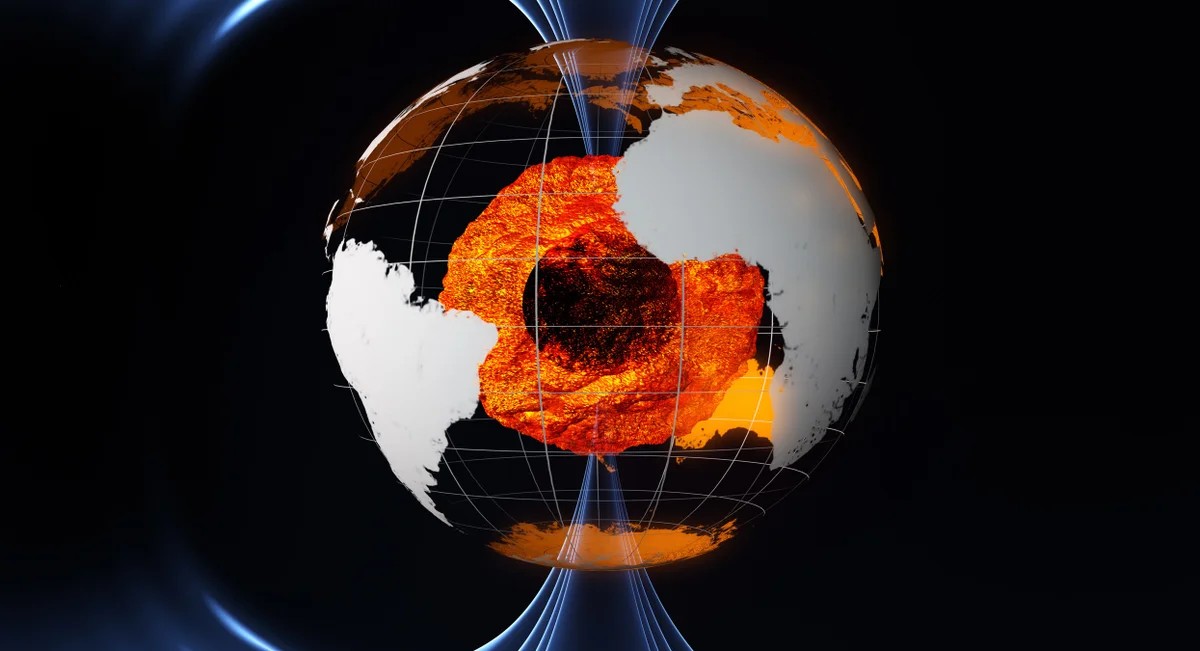
Down there, nearly three thousand kilometers under your feet. It is a churning ocean of molten iron. Liquid rock swirling around the solid inner core. It generates the magnetic shield that keeps cosmic radiation off us. Without it, we’d be in trouble.
Usually, the system runs on a predictable rhythm. The solid inner core spins east. Just like Earth does. But the liquid outer core? That stuff tends to drift west. Opposite directions. A steady, grinding counter-flow that scientists thought they had figured out.
Until 2010.
Then everything stopped. Or rather, reversed.
New analysis shows that flow beneath the Pacific Ocean suddenly snapped. It didn’t just slow down. It switched. West became east. For a decade, the liquid metal surged backward. Then, around 2020, it weakened again. A blink in geological time. A lifetime for data analysts.
The data is real. Scientists dug through archives from 1997 to 2025. They looked at readings from the European Space Agency’s Swarm satellites. They checked CryoSat-2 data, which monitors polar ice. They even pulled in old stats from Germany’s CHAMP and Denmark’s Ørsted missions. Ground observatories backed it up too. All pointing to one thing. Anomalous flow.
The large-scale flow reversal beneath the Pacific is not a glitch. It’s a message from the deep.
Why? Nobody knows. Not exactly. But it’s suspicious timing. Other data hints at shifts inside the inner core itself. Maybe the solid heart is nudging the liquid shell. Maybe the two are tangled in a way we never appreciated.
Frederik Dahl Madsen, lead author on the study from Edinburgh, thinks we need to ask harder questions. Is this a one-off fluke? A hiccup in the system. Or is it a sign that the core is unstable. Chaotic.
We assumed stability. We assumed the deep Earth was boring, consistent, reliable.
It might be more like the weather. Unpredictable. Shifting. Complex.
What Does It Matter?
It matters if your phone connects. Or your satellite stays in orbit. Or you want to breathe oxygen without filtering out lethal rays.
The magnetic field protects us. But if the engine that powers it is sputtering or changing gears, the field could weaken. Or flip. Or behave strangely.
Elisabetta Iorfida, a scientist on the Swarm mission, isn’t surprised. She expects the unexpected. The more we look, the weirder the planet gets. The core is dynamic. It is alive, in its own fiery way.
So what next?
We wait. We watch. We measure.
There are no easy answers down there. Just hot iron and mysteries. The Pacific flow changed once. It might change again. The question isn’t if the Earth will surprise us.
It’s what it will do next.