In the natural world, a physical disability is often viewed as a death sentence or, at the very least, a permanent social disadvantage. However, a remarkable case study involving a Kea parrot named Bruce is challenging our understanding of how animals navigate social hierarchies.
New research published in Current Biology suggests that Bruce has not only survived a severe injury but has leveraged it to become the dominant male in his social group.
From Injury to Innovation
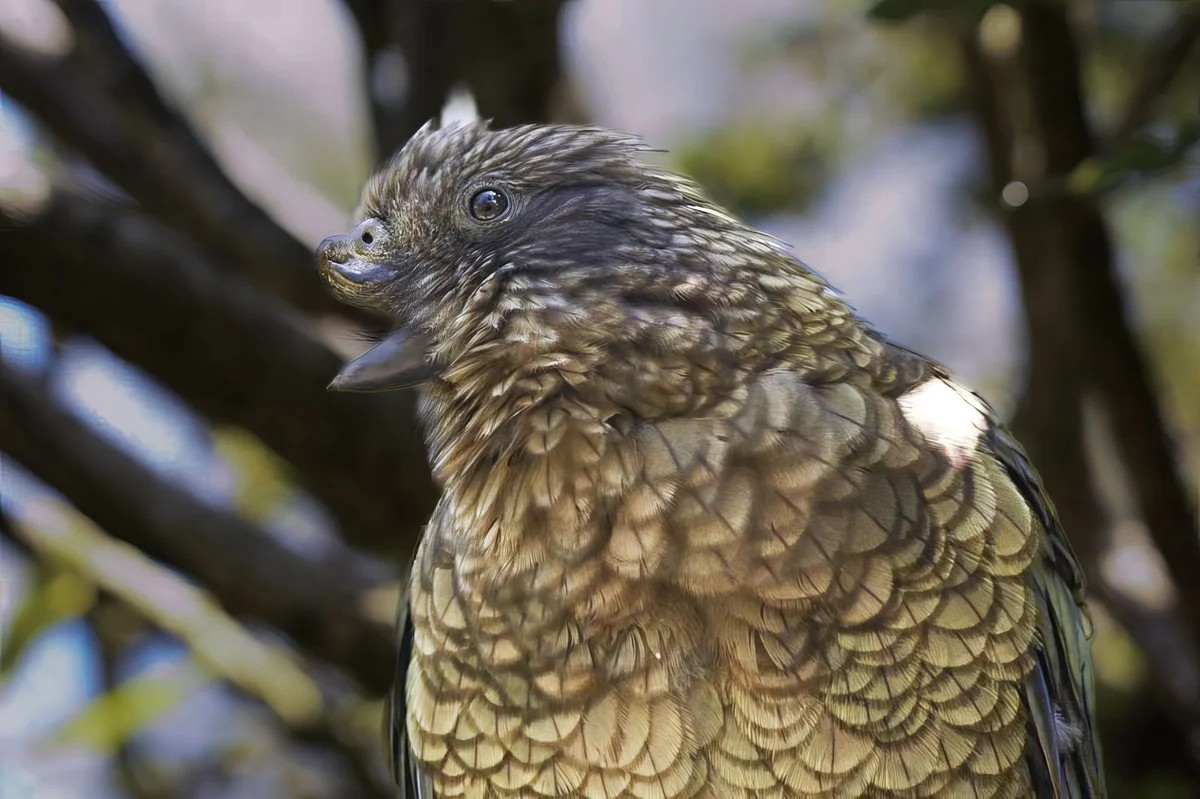
Bruce, a Kea (Nestor notabilis ) living at New Zealand’s Willowbank Wildlife Reserve, lost the curved upper portion of his beak during a fledgling injury on the South Island. While this left him unable to perform standard parrot behaviors—such as efficient preening or feeding—it also exposed his sharp, pointed lower beak.
Rather than being sidelined by this deformity, Bruce developed a unique combat style that researchers describe as “jousting.” His tactical approach involves:
– Crouching low to the ground.
– Gaining momentum with a running start.
– Leaping at opponents with his chin thrust forward.
By targeting the wings, legs, and faces of other birds with his exposed lower beak, Bruce has turned a physical deficit into a highly effective weapon. The results are clear: other birds in his group react with immediate alarm, often leaping away to avoid his lunges.
The “Aloof” Leader: Social Dynamics of the Circus
In Kea society, a social group is referred to as a “circus.” Typically, males maintain dominance through constant squabbling and aggressive threat displays. Bruce, however, has bypassed these exhausting rituals.
Because his “jousting” is so effective, he can maintain dominance with less effort. The study notes several fascinating aspects of his leadership:
– Resource Monopoly: Bruce can wander freely, monopolizing prime perches and feeding stations without constant challenge.
– Social Deference: Other males show him high levels of respect, sometimes even grooming him—a behavior usually reserved for a mate.
– Low Stress: Analysis of his waste revealed that Bruce possesses the lowest stress hormone levels of any male in the circus.
– Conflict Mediation: Far from being a mere bully, Bruce has been observed intervening to break up fights between subordinate males, acting as a stabilizing force in the group.
The Intelligence of the Kea
This phenomenon highlights the extraordinary cognitive abilities of the Kea. Known as the “hooligans” of the bird world, Keas are famous for their high intelligence and problem-solving skills, often engaging in complex behaviors like making snowballs or using tools.
Bruce’s survival is a testament to behavioral innovation. When faced with the inability to preen traditionally, he was observed using a pebble as a tool to clean himself. This “stick-to-itiveness”—a combination of curiosity and persistence—allows him to find workarounds for tasks that would otherwise be impossible.
“Because of his disability, he has had to innovate behaviors. He’s found a way to make himself more dangerous,” says Ximena Nelson, a professor of animal behavior at the University of Canterbury.
The Complexity of Welfare
While Bruce’s social success is undeniable, researchers urge a nuanced view of his condition. Raoul Schwing, a researcher who has followed Bruce for over a decade, notes that being “top dog” does not negate the physical challenges Bruce faces. While his social status is high, his daily life remains more difficult than that of a healthy parrot, leading some to suggest that prosthetic interventions could still improve his overall welfare.
Conclusion
Bruce’s story demonstrates that in highly intelligent species, physical limitations can serve as catalysts for behavioral innovation. By adapting his combat and survival strategies, he has transformed a biological disadvantage into a unique mechanism for social dominance.