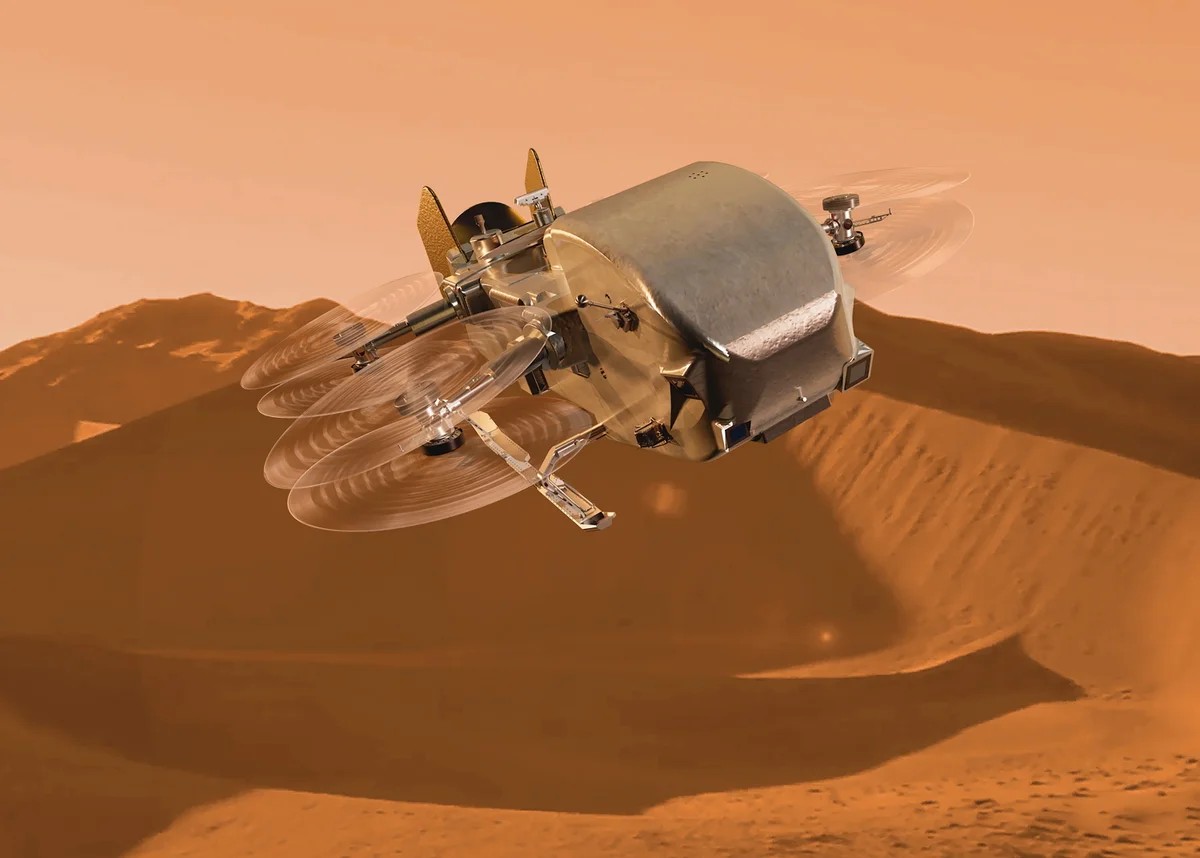
In 2034, humanity will be exploring a distant, frozen world—not with footsteps, but through the rotors of a sophisticated robotic drone. NASA is preparing to launch Dragonfly, an ambitious mission designed to fly across the surface of Titan, Saturn’s largest moon, to unlock the mysteries of its alien chemistry and search for the building blocks of life.
Why Titan is a Scientific Priority
Titan is not just another moon; it is a world of profound geological and chemical complexity. Larger than the planet Mercury, Titan is the only moon in our solar system known to possess a dense atmosphere. While its surface is brutally cold—averaging roughly –180 degrees Celsius —it possesses a feature strikingly similar to Earth: a liquid cycle.
Instead of water, Titan features lakes and rivers of liquid methane and ethane. This creates a “methane cycle” where liquid evaporates, forms clouds, and precipitates back to the surface as rain or snow. Because methane and ethane are carbon-based molecules, Titan represents a unique laboratory for studying how organic chemistry might lead to the precursors of life.
The Challenge of Exploration: Why Fly?
Exploring Titan presents significant hurdles that have stymied previous mission designs:
– The Distance: At over a billion kilometers from Earth, human presence is currently impossible.
– The Terrain: Traditional rovers risk getting stuck in the moon’s unpredictable, hazy terrain.
– The Environment: Previous missions, like the ESA’s Huygens probe, were limited by short lifespans and a single landing point.
To overcome these, NASA has opted for flight. Paradoxically, Titan is an ideal place for a drone. Its atmosphere is 1.5 times thicker than Earth’s, providing excellent lift, while its gravity is only 14% of Earth’s, making it much easier for a craft to stay aloft.
Engineering the Octocopter
Dragonfly is a massive, highly specialized machine. Unlike small consumer drones, this “octocopter” is a heavy-duty scientific laboratory:
- Design: An 875-kilogram craft featuring four pairs of counter-rotating blades to maximize lift and stability.
- Power Source: A Multi-Mission Radioisotope Thermoelectric Generator (MMRTG). This nuclear battery uses the heat from decaying plutonium to generate electricity and keep the craft warm in the cryogenic cold.
- Scientific Payload: The drone is equipped with a mass spectrometer for chemical analysis, a drill for subsurface sampling, a mineral mapper, and advanced meteorological instruments.
The Mission Roadmap
The journey is a multi-stage marathon. Following a planned launch in July 2028, Dragonfly will spend six years cruising through deep space.
- Descent: The craft will undergo a high-stakes atmospheric entry, using a heat shield and parachutes to slow down.
- Autonomous Landing: Using radar and lidar, the drone will autonomously select a landing site in the Shangri-La region—an area characterized by vast dunes made of frozen hydrocarbons.
- Exploration: Once landed, Dragonfly will perform a series of flights, including a trip to the Selk crater. By sampling material excavated by ancient impacts, the mission aims to peer deep into Titan’s inner structure.
The Big Picture: Searching for Life
The ultimate goal of Dragonfly is to answer whether Titan’s complex organic chemistry has produced the precursors for life. Whether scientists find evidence of biological activity or simply a complex “pre-biotic” soup, the mission will fundamentally change our understanding of where life can exist in the universe.
Even if Titan proves to be lifeless, the mission will provide critical data on how organic chemistry behaves in extreme, cryogenic environments, redefining our search for life on other worlds.
Conclusion
Dragonfly represents a leap forward in planetary exploration, moving from static landers to dynamic, flying laboratories. By navigating the thick atmosphere of Titan, NASA aims to bridge the gap between observing a distant world and truly interacting with its complex, alien landscape.