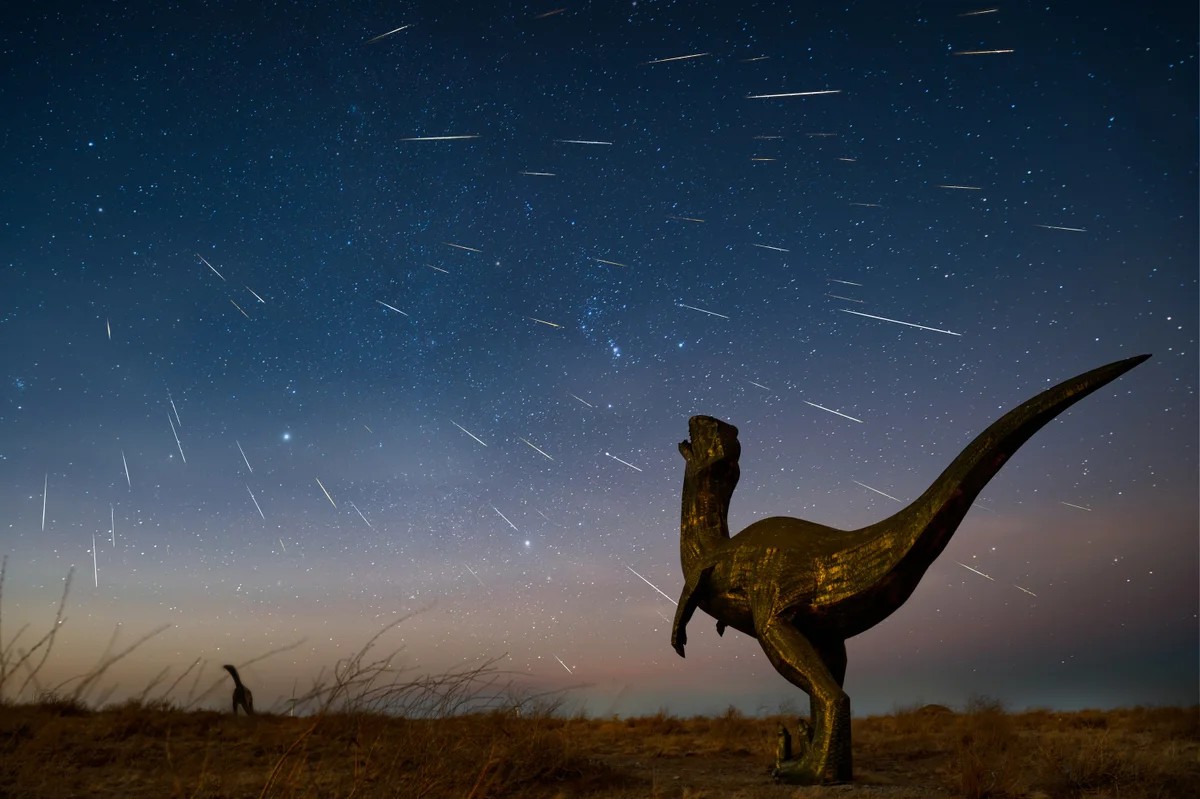
A reader’s question about the visibility of dinosaurs from 66 million light-years away reveals surprising implications for future astronomical projects. The thought experiment isn’t just bizarre—it highlights the extreme challenges of resolving objects at cosmic distances, while simultaneously underscoring the potential for eventual exoplanet observation.
The Problem of Distance and Time
If aliens existed 66 million light-years from Earth, they would be observing our planet as it was 66 million years ago. The Chicxulub asteroid impact, which wiped out the non-avian dinosaurs, would just now be reaching them as light. The question isn’t whether they could see dinosaurs, but whether their technology could resolve something so distant and faint.
Calculating the Apparent Size
To determine the required telescope size, we must first calculate the apparent size of a 10-meter Tyrannosaurus rex at that distance. Using the small-angle approximation, the dinosaur would appear at approximately 10-21 degrees—an incomprehensibly tiny fraction of a degree. This means resolving it requires extreme precision.
The Telescope Scale Problem
Resolving an object that small demands a telescope mirror with a diameter of roughly 3.2 x 10¹⁶ meters, or 3.4 light-years across. Such a mirror would dwarf entire star systems and require a mass of over 1030 metric tons—more than 100 million times the mass of Earth. Constructing such a telescope isn’t just difficult; it’s physically improbable with current materials and technology.
Interferometry as a Potential Solution
An astronomical interferometer, using multiple smaller telescopes spread across vast distances, could theoretically mimic the resolution of this impossible mirror. Even so, the material requirements would remain absurd: trillions of metric tons of mirror mass.
Real-World Implications for Exoplanet Observation
While observing long-dead dinosaurs is impractical, the core challenge remains relevant. Astronomers aim to build telescopes capable of resolving surface features on exoplanets—distant worlds orbiting other stars. Achieving this, even at a more realistic 10 light-years, requires an array stretching hundreds of kilometers. Though beyond our current capabilities, this feat is within reach in coming decades.
Seeing continents on an exoplanet is not science fiction; it’s a matter of engineering and commitment. The principles are clear, and the human brainpower exists.
The question about dinosaurs isn’t just a thought exercise. It’s a reminder that the universe demands extreme measures to reveal its secrets, but those measures are not always beyond our grasp.