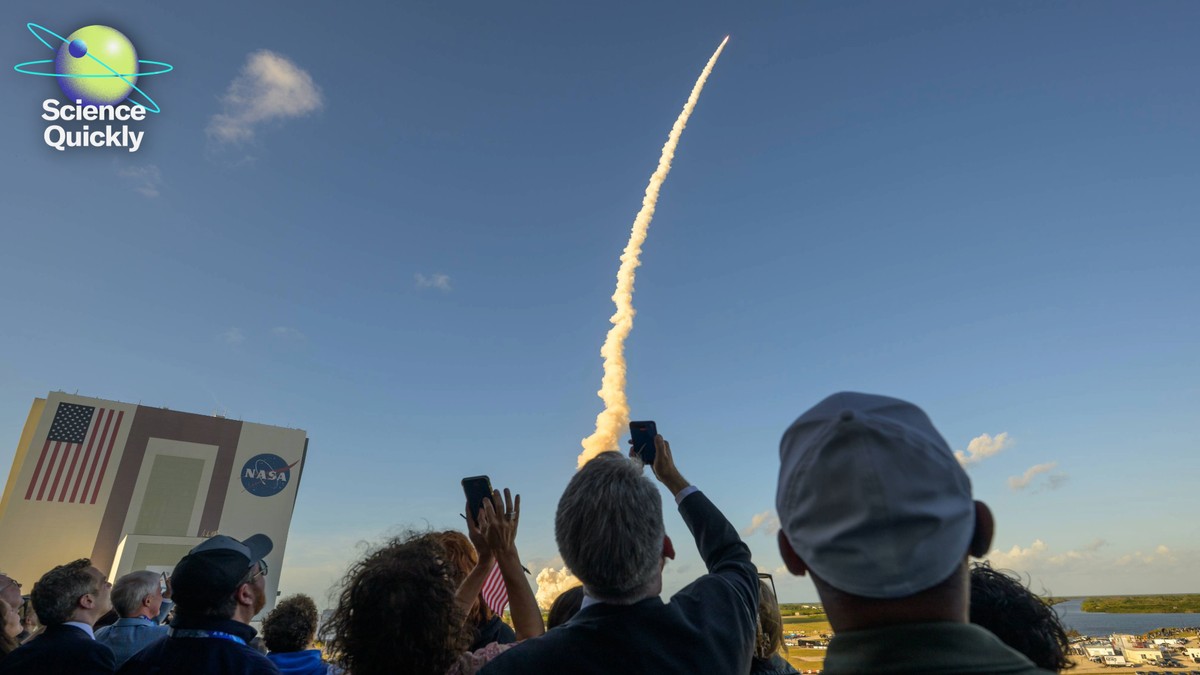
NASA successfully launched the Artemis II mission on Wednesday evening after multiple delays, marking the first crewed lunar flyby since 1972. The four astronauts – Reid Wiseman, Victor Glover, Christina Koch, and Jeremy Hansen – will not land on the Moon, but will instead slingshot around it, potentially venturing further into space than any human before. This mission represents a crucial step in NASA’s long-term goal of establishing a sustainable lunar presence and eventually, pushing deeper into the solar system.
The Launch and Initial Systems Check
The launch itself was remarkably smooth, according to space and physics editor Lee Billings of Scientific American. Previous attempts faced issues with the Space Launch System (SLS) megarocket, including propellant leaks, particularly highly flammable liquid hydrogen. This time, NASA skipped the typical “wet dress rehearsal” – a full fuel loading test – and proceeded directly to launch, which proved successful.
This decision underscores a growing confidence in the SLS system, though it also highlights the inherent risks of space travel. As Billings pointed out, even with meticulous planning, unforeseen problems can arise. The Artemis II crew are essentially test subjects, pushing the Orion spacecraft and its life-support systems to their limits.
Key Milestones and Concerns
Several critical phases lie ahead. The translunar injection burn – a six-minute engine firing to propel the spacecraft towards the Moon – has already occurred. Next comes the atmospheric reentry, arguably the most dangerous part of the mission.
The Orion capsule will hit Earth’s atmosphere at roughly 25,000 miles per hour, generating extreme heat. The spacecraft’s heat shield must function flawlessly to prevent the astronauts from being incinerated or the capsule from disintegrating.
Previous tests with the uncrewed Artemis I mission revealed unexpected damage to the heat shield, with chunks missing after reentry. NASA has not altered the shield’s design but has adjusted the reentry profile to reduce stress on the material. The steep angle of descent is expected to minimize exposure time to the most intense heat.
Beyond the Moon: A Lunar Outpost and Scientific Goals
The Artemis program’s ultimate objective is not just revisiting the Moon, but establishing a permanent lunar outpost, particularly around the south pole. This region holds potential reserves of water ice, which can be converted into drinking water, rocket fuel, and even agricultural resources.
The lunar south pole also offers ideal conditions for scientific research. The far side of the Moon is shielded from Earth’s radio interference, making it an excellent location for a radio telescope array. Such an array could detect faint radio waves from the universe’s earliest epochs, offering insights into the “cosmic dark ages” before stars and galaxies formed.
A Return to Lunar Exploration
The decision to return to the Moon raises a fundamental question: why go back? Some argue that the Moon is a stepping stone for deeper space exploration. It’s closer and more accessible than Mars, providing a valuable testing ground for technologies and strategies needed for interstellar travel.
Furthermore, the Moon may hold clues about its own formation and the early history of the solar system. Investigating its geology, seismic activity, and potential volcanic remnants could shed light on the Moon’s origins and its relationship to Earth.
The Artemis program is not without critics, particularly those who question the allocation of resources in the face of pressing terrestrial challenges. Yet, space exploration remains a driving force for innovation and scientific discovery. Whether the long-term benefits outweigh the costs is a debate that will likely continue as the Artemis missions progress.
Ultimately, Artemis II is a critical test flight, pushing human spaceflight technology to its limits and laying the foundation for a sustained presence beyond Earth. The mission’s success is not just a triumph of engineering but a bold step toward unlocking the secrets of our universe.