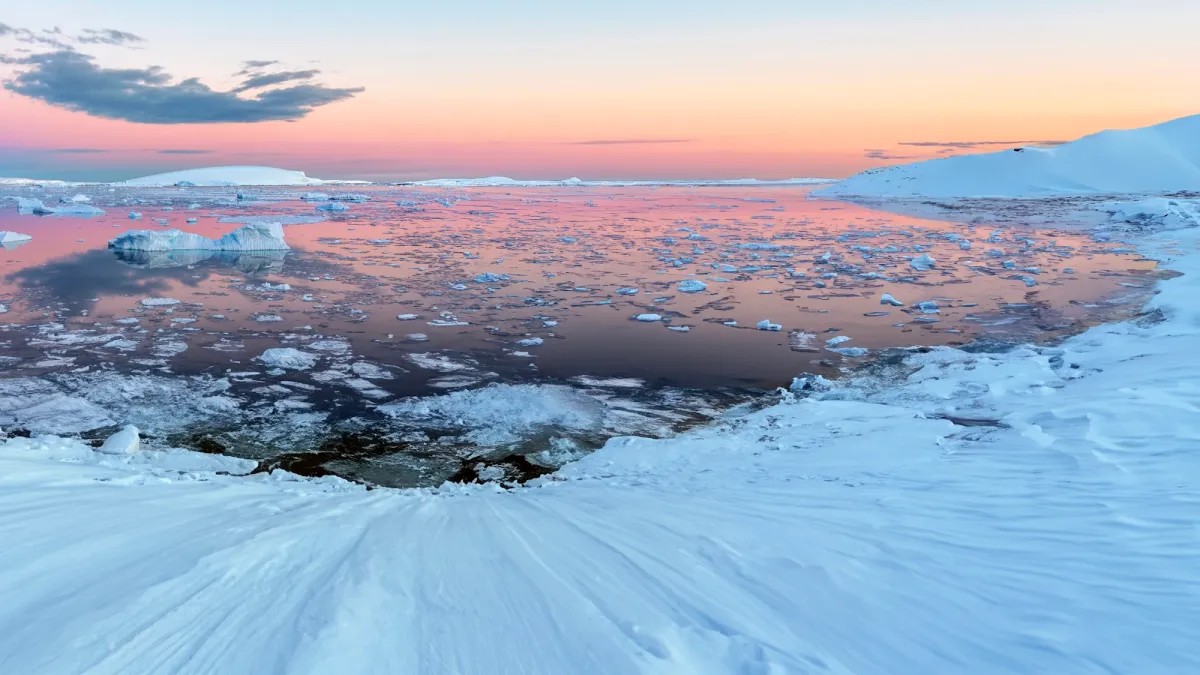
Antarctica harbors a massive, long-lived anomaly in Earth’s gravitational field—dubbed a “gravity hole”—that researchers are now using to unlock mysteries about the continent’s past and future climate. This isn’t a science fiction scenario but a measurable phenomenon stretching back tens of millions of years, where variations in rock density create localized gravitational imbalances. The implications reach far beyond the Antarctic, influencing global sea levels and ecosystem stability.
The Physics of Imbalance
Gravity isn’t uniform across Earth; it fluctuates based on mass distribution. Beneath Antarctica, areas of lower rock density result in weaker gravitational pull, causing ocean surfaces to dip accordingly as water flows toward stronger gravity zones. This effect is most pronounced in the Antarctic Geoid Low (AGL), the continent’s gravity hole.
The AGL didn’t appear overnight but evolved over millennia, growing stronger over time. Researchers now utilize earthquake waves—akin to a planetary CT scan—to map these internal differences. Seismic data, combined with satellite analysis and advanced computer modeling, allows scientists to reconstruct how these gravitational anomalies shaped Antarctica over the past 70 million years.
Unlocking the Past Through Earthquakes
“Imagine doing a CT scan of the whole Earth, but we don’t have X-rays like we do in a medical office. We have earthquakes,” explains Alessandro Forte, a geophysicist at the University of Florida. Earthquakes generate waves that penetrate the Earth’s mantle, providing “light” to illuminate its interior structure.
The study, published in Scientific Reports, reveals that Antarctica’s gravity hole began to intensify around 30–50 million years ago, coinciding with major shifts in climate and the expansion of glaciers. These shifts in gravity directly influence Earth’s ecosystems, including sea levels and ocean acidity.
Why This Matters
Understanding this phenomenon isn’t just academic. The evolution of Antarctica’s gravity hole provides critical insights into how Earth’s interior processes affect surface-level conditions.
“If we can better understand how Earth’s interior shapes gravity and sea levels, we gain insight into factors that may matter for the growth and stability of large ice sheets,” Forte stated.
The research team plans to further investigate the connection between a strengthening gravity hole and ice sheet development. By analyzing these deep-Earth interactions, scientists hope to improve predictions about future climate change and sea-level rise.
The Antarctic gravity hole is a reminder that Earth’s systems are interconnected in complex ways. Studying these hidden forces is crucial to understanding the planet’s long-term stability and our own future on it.