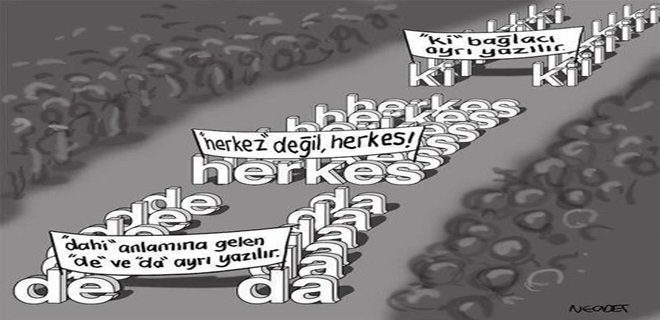
The spelling error that occurs when the conjunction “de” and the derivational suffix “-de” are mixed is like a slight shrill joke for those who know the rules of grammar. Not for those who consciously make this mistake. That “I’ve made a mistake” feeling is a kind of nervous breakdown familiar to anyone with a desire to conform. Writing Turkish is not just about memorizing vocabulary. Correct placement and writing of suffixes are the cornerstones that preserve the semantic integrity of the sentence.
Yes, language structure is complex. But in terms of depth of meaning and power of expression, Turkish is a much more flexible and rich tool compared to many European languages. In order not to lose this richness, we have to understand the functions of suffixes.
Just because? Understanding the difference between conjunction and affix
The clearest way to remove the question mark is to look at the functions that distinguish these two structures. The conjunction “de” is an independent part that establishes a relationship with other words and adds meaning to the sentence. The suffixes “-de/-da/-de/-da” are an adjacent part placed on a noun or pronoun, indicating the place, situation or action of that word.
To avoid confusion, you can apply the following practice tests. These methods allow you to make quick decisions in exams or daily correspondence.
1. Test by replacing it with “da”
In Turkish, the conjunction “de” can always be replaced with “da”. They both function the same. The attachment does not change.
- Correct usage: “I’m coming too.” -> “I’m coming too.” (The sentence remains logical. Conjunction.)
- Misuse: “I also** read the book.” -> “I also read the book.” (The meaning is distorted or the sentence remains incomplete. Here the suffix is missing, the conjunction is in the wrong place.)
- Correct usage: “There’s a pen on your**desk.” -> “There’s also a pen on your desk.” (The second “da” is a conjunction. “De” is not used.)
If you can write “da” without changing the meaning of the sentence, it is a dot conjunction. If it cannot be written, it is a structure that looks for an addition.
2. Can it be separated? conjunction separate, additional adjacent
According to Turkish spelling rules, conjunctions are written separately. Suffixes are written in conjunction.
- Conjunction: “He also comes.” (Written separately.)
Finding the Right “de”: Attachment vs. separation
This rule seems simple, but even native speakers make mistakes. The suffix -de is attached directly to the root word. Indications a location or state. On the street. In the corner. In the book. We write it together because it is part of the noun’s identity. Answer where something is. Answer what state something is in.
The conjunction de is different. It builds bridges of ideas. Combine the expressions. But how do you know which one is needed in a given sentence?
Identifying conjunctions
Look for similarity, equality, or addition. The conjunction de joins words or sentences with a preceding element that has the same grammatical role. It says “me too” or “me too”.
Consider the following interaction:
I want to go to the cinema today, not the theater.
Me too.
Here de is added to “I”. Add the speaker to the previous sentence. It’s a connector. It is not a location marker.
When “De” Emphasizes or Diminishes
The conjunction de is more than just a conjunction. It can intensify. It stands by itself even when used to emphasize meaning or show exaggeration.
Examples:
“The exam is also an exam,” he insisted.
Repetition accentuates stress. The separation highlights the frustration.
On the other hand, de can express contempt. It can create a negative or condescending tone.
Examples:
He said he would come early and we would make it.
Gaps between words indicate a lack of seriousness. This means that the promise is empty.
Why this distinction is important
If you mix endings and conjunctions, the meaning changes. The tone changes. Syntax changes.
- Use -de (attachment) as location. Where is the box? In the box.
- Use de (separate) for addition. Me too.
- Use de (alone) for emphasis. Really?
- de (alone) has a derogatory meaning. Of course, whatever.
Check the text. If the word adds a “where”, attach it to the root. Leave a space if it adds a “also” or a “really”.

There is a simple rule to distinguish the two most confused topics in Turkish. Foreigners are usually confused by this rule, but even native Turkish speakers are sometimes surprised. Is “de” a conjunction or a suffix? To find the answer, all you have to do is give it a try.
Delete “de” from the sentence.
Don’t close your eyes.
Has the meaning changed?
Here’s the key.
Is it an addition? Is the Meaning Distorted?
If the logic of the sentence collapses completely or the words remain meaningless when you remove “de”, it means the “de” suffix.
Let’s clarify this with an example.
“I have a pen in the box, can you give it to me?”
Now let’s remove the “de”.
“I have a pen, can you give it to me?”
Stop.
Can a box be a pen?
No.
This sentence has become meaningless.
The meaning is completely distorted.
So here “da” is a suffix.
One of the location suffixes. It indicates the location. He says it’s in the box. The moment you remove it, that position disappears.
Conjunction? Does the Meaning Change But Does It Collapse?
The second scenario is more subtle.
When you remove “de”, the meaning changes, but the sentence does not become meaningless.
The message remains the same.
Only the emphasis or scope changes.
Let’s see.
“I understand you too, but not as much as he does.”
Delete the “de”.
“I understand you, but not as much as he does.”
Has the meaning changed?
Yes.
When “de” comes out, do I understand it or does someone else? Has it become unclear? Maybe.
But is the sentence broken?
No.
I still say I understand you.
The “including me” meaning of the original may be gone, but the core message remains intact.
So this is a conjunction.
Conjunctions complete the meaning, they do not break up the sentence.
Annexes are part of the structure. The moment you break it, the structure breaks down.
How Do You Apply It in Practice?
To use this test in daily life, you need to work your mind a little faster.
You add “de/da” to places where you get stuck while writing.
Can you go back and delete it later?
Is the integrity of meaning broken?
If it spoils, add it.
If it changes but the integrity remains, it is a conjunction.
This distinction is not just for exam questions.
write more clearly

-ki suffix or ki conjunction? Stop Mixing
We talked about the “de/de” distinction before. Now it is time to use the conjunction “ki” and the “-ki” suffix. Both concepts are among the points that create the most confusion in Turkish. But the rule is simple.
The relative suffix -ki is written adjacent to the word.
The conjunction ki is written separately.
So how do we know which is which?
Relative Suffix -ki: Written adjacently
The suffix -ki indicates the affiliation and relevance of the noun to another noun or pronoun. It is used as an adjective in the sentence.
How?
It is not independent of the word itself. It stands adjacent to each other in its semantic integrity.
“Flower in the garden”
“Banana in the cupboard”
“The man of that day”
As you can see, they are all adjacent. From where? Because “-ki” connects the situation, position or quality of that noun to something else. When it sees this structure, the pen should automatically move to write adjacently.
Conjunction Ki: Written Separately
The conjunction “ki” establishes a semantic link between sentences or words with sentence value.
How does it work?
It connects the first part to the second part. It provides a logical transition.
“He became so cold that he forgot what happened in the past.”
Here, “that” is a bridge that establishes the causality or effect relationship between “he had become so cold” and “he had forgotten what happened in the past”. It must be written separately.
There is also the conjunction “ki” that reinforces the narrative. It is usually used with exclamations.
“He never cried!”
This usage is also separate. It emphasizes and intensifies the emotion.
Formulaic Words: “ki” is written adjacently here
There are a few exceptions. In some words, the conjunction “ki” has merged into the word over time. These are now adjacent phrases.
- Maybe
- Because
- As if
- However
- Whereas
- Turns out
- Since
It would be wrong to try to divide the items in this list into two parts while writing. They should all be treated as one word.
Quick Checklist
If you get confused while typing, do this:
- Does the literal meaning connect one thing to another?
- If yes -ki (adjacent).
- Does it establish a semantic link between sentences?
- If yes **that