Think about the sheer scale of human communication. You are likely speaking or listening to an Austronesian language right now, even if you don’t realize it. This massive linguistic family includes over 1,200 distinct languages. They are spoken by more than 200 million people. The reach is staggering.
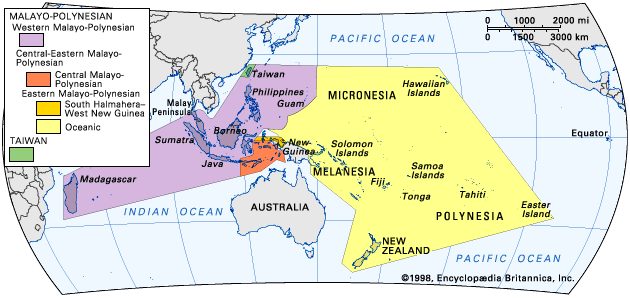
These languages span from the island of Taiwan in the north all the way down to Madagascar in the Indian Ocean. They cover most of Indonesia and the Philippines. They dominate the central and southern Pacific islands. You’ll find them in parts of mainland Southeast Asia too. The only major gap in this map is most of New Guinea. There, you encounter Papuan languages instead.
Before European colonial powers expanded their borders, the Austronesian languages held the widest territorial spread of any language family in human history. That is a massive claim. But the data supports it. The geography alone tells a story of incredible migration and adaptation.
The Roots in Taiwan
Linguists trace the genetic origins of this family back to Taiwan. The primary division in the family separates the Austronesian languages of Taiwan from everything else.
The rest of the languages fall into two main groups: Western Malayo-Polynesian and Central-Eastern Malayo-Polynesian. This split is fundamental. It explains why languages so far apart still share structural similarities.
Western Malayo-Polynesian includes Javanese. This single language accounts for about 76 million speakers. That is more than a third of all Austronesian speakers worldwide. If Javanese were a standalone language family, it would be among the most significant in the world.
The Oceanic Expansion
The Central-Eastern branch leads to Eastern Malayo-Polynesian. Within this group is Oceanic. This is the best-defined subgroup of the entire family.
It comprises nearly all the languages of Polynesia, Micronesia, and Melanesia. The diversity here is high. The distance between island groups is vast. Yet the linguistic links remain clear.
Typological generalizations are difficult. The number of languages and their diversity make broad rules hard to pin down. However, some patterns emerge. Content words tend to be disyllabic. Vowel and consonant inventories are limited. This is especially true in Polynesian languages.
Writing and History
Written records exist for several of these languages. They use scripts of Southeast Asian provenance. These are often linked to Indic writing systems.
Old Javanese survives in these records. So does Cham, the language of the kingdom of Champa. These texts provide a window into the past. They show how these languages evolved before modern colonial influence.
The Austronesian expansion represents one of the most remarkable chapters in human migration.
Why did these languages spread so far? The answer lies in navigation. The people who spoke these languages mastered the oceans. They moved across thousands of miles of open water. They settled islands that had never been inhabited before.
This movement shaped the cultural and linguistic landscape of the Indo-Pacific. It created a web of connections that persists today. Understanding this history helps us understand the diversity of the modern world.
Which languages will survive the next century of globalization? That is a question for the future. For now, the legacy of the **