
Adding fractions isn’t just a math class hurdle. It’s a real-world skill. You use it when splitting a pizza, measuring ingredients for cookies, or calculating time. But if you are staring at two different denominators, it can feel like a puzzle with no solution.
At its core, adding fractions is simple arithmetic. It involves combining two or more fractional numbers. A fraction represents parts of a whole. It always has two parts: the numerator (the top number) and the denominator (the bottom number).
The numerator counts how many parts you have. The denominator tells you how many equal parts make up the whole.
Think of it this way. If you have one slice of an eight-slice pizza, you have 1/8. If your friend has another 1/8, you have two slices total. This is easy because the slices are the same size.
But what happens when the slice sizes are different?
This is where most people get stuck.
You cannot simply add the numerators if the denominators differ. It’s like trying to add apples and oranges. Or inches and centimeters. The units don’t match. To add them, you must make the units identical.
This process is called finding a common denominator.
Once the denominators match, the fractions represent parts of the same size. Now the addition becomes straightforward. You just add the top numbers. The bottom number stays the same.
Understanding this mechanic is key. It applies to everything from basic algebra to cooking recipes. When you grasp how to align the parts, the math stops feeling arbitrary. It becomes a logical system.
Students often fear this step. Parents helping with homework might feel it too. The fear usually comes from the fear of the “wrong answer.” But there is a method. And the method is repeatable.
In the next sections, we will break down exactly how to handle like denominators and unlike denominators. We will look at common mistakes and how to fix them quickly. You do not need to be a math whiz. You just need to follow the steps.
When denominators match, keep it simple
You don’t need complex formulas when adding fractions that already share the same bottom number. If the denominators are identical, the math is straightforward. You just add the top numbers (numerators) and keep the common denominator exactly as it is.
Take a look at this example:
$$ \frac{1}{5} + \frac{2}{5} + \frac{3}{5} $$
The denominator for all three fractions is 5. Because they already match, you ignore the five for a moment and focus entirely on the numerators. Add 1, 2, and 3 together to get 6. Your new fraction is simply $\frac{6}{5}$. Done.
Tackling unlike denominators
Things get trickier when the denominators differ. You cannot add fractions with different bottoms directly. It doesn’t work that way. First, you have to make them the same. Once you have a common denominator, you can finally sum the numerators.
For adding just two fractions with different denominators, the butterfly method is often the go-to strategy. It’s visual, it’s quick, and it usually prevents errors in cross-multiplication.
Here is how you apply the butterfly technique to an example.
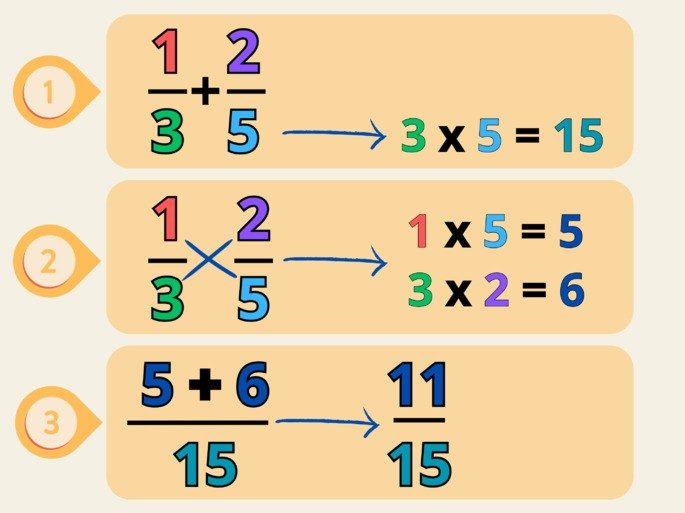
Adding two fractions with different denominators requires finding a common ground. You start by calculating the resulting denominator. The shortcut is simple: multiply the two denominators together.
Once you have that bottom number, you need the new numerators. This is where the butterfly method comes in. It sounds fancy, but it is just cross-multiplication. Take the numerator of the first fraction and multiply it by the denominator of the second. Then, do the reverse. Multiply the numerator of the second fraction by the denominator of the first. Add those two products together. That sum becomes your new numerator. The result? The final fraction.
Adding Three or More Fractions
What happens when you have three, four, or more fractions to add? Multiplying denominators works, but it often creates massive numbers that are hard to simplify. In these cases, use the least common multiple (LCM).
Let’s look at a concrete example. Say you are adding fractions with denominators 4, 6, and 8. Finding the LCM of these numbers gives you the common denominator. It is 24.
Now for the numerators. Divide the LCM (24) by the original denominator of each fraction. Then, multiply that result by the original numerator. You repeat this for every fraction in the set.
- Divide 24 by the first denominator, multiply by its numerator.
- Divide 24 by the second denominator, multiply by its numerator.
- Repeat for the third.
Add up all the new numerators you just calculated. Place that sum over the LCM denominator. You have your answer.
“When adding multiple fractions, the LCM keeps the numbers manageable compared to simple multiplication of all denominators.”
See also: [Least Common Multiple (LCM)] and [Equivalent Fractions].
Adding Mixed Numbers
Mixed numbers add a layer of complexity because they combine whole numbers with fractions. The cleanest way to handle this is separation. Split each mixed number into its integer part and its fractional part.
Add all the whole numbers together. Then, add all the fractional parts together using the methods described above for different denominators. If the fraction sum is greater than one, convert it to a mixed number and add the whole number to your total sum of integers. It is less prone to error than converting everything to improper fractions first.
Why does this matter? Because it forces you to keep track of the magnitude of the number. You see the whole part clearly. It prevents the common mistake of forgetting to carry over an extra whole number when the fractional sum exceeds one.
Students often skip this step. They rush to convert to improper fractions. While valid, it increases the chance of arithmetic errors with larger numerators. Separation is safer. It is also faster once you get the hang of it.
Parents helping with homework might find this approach more intuitive. It mirrors how we actually speak about quantities. “Two and a half cups plus one and a quarter cups.” We handle the cups and the fractions separately in our heads. Teaching this logic builds a stronger number sense than rote memorization of algorithm steps.
Lifelong learners in the workforce might encounter this in construction or cooking. Precision matters. But so does speed. Knowing which method fits the specific numbers at hand is a skill.
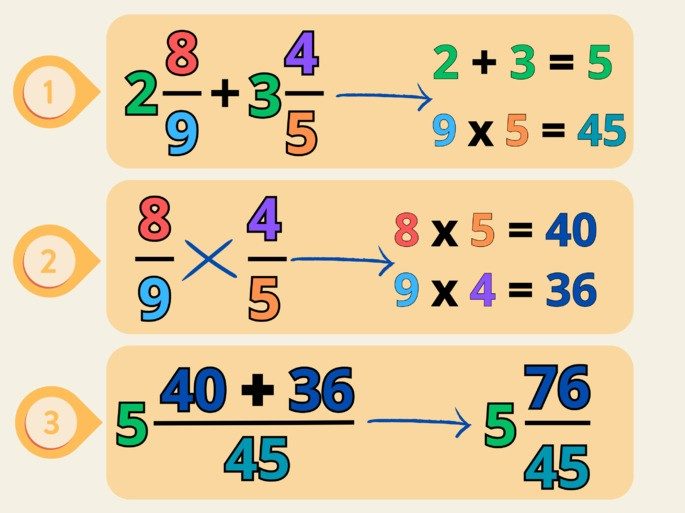
Adding fractions often trips up students because of one recurring headache: different denominators. If the bottoms match, you just add the tops. Simple. But when they don’t, you need a strategy.
There are two main ways to tackle this. The butterfly method is great for quick, two-fraction sums. It’s visual and requires no big number crunching. The LCM (Least Common Multiple) method scales better. Use it when you have three or more fractions, or when the numbers get messy.
Let’s break down exactly how these work with concrete examples.
Adding Two Fractions with Different Denominators
When you have two fractions, the butterfly method is often the fastest route. It avoids finding a common denominator explicitly. Instead, it cross-multiplies.
Exercise 1
Solve: $4/7 + 3/5$
Step 1: Multiply the denominators.
$7 \times 5 = 35$
This becomes your new denominator.
Step 2: Multiply in a cross pattern for the numerators.
Take the top of the first fraction and multiply by the bottom of the second:
$4 \times 5 = 20$
Take the top of the second fraction and multiply by the bottom of the first:
$3 \times 7 = 21$
Step 3: Add these results.
$20 + 21 = 41$
The result is $41/35$. Since the numerator is larger than the denominator, you can convert this to a mixed number.
$41 \div 35 = 1$ with a remainder of $6$.
Final answer: $1 \ 6/35$.
Summing Mixed Numbers
Mixed numbers add an extra layer: you have whole numbers AND fractions. The trick is to handle them separately.
Exercise 2
Solve: $2 \ 3/8 + 5 \ 1/3$
Step 1: Add the whole numbers first.
$2 + 5 = 7$. Keep this number safe. You’ll add it back at the end.
Step 2: Focus only on the fractional parts: $3/8 + 1/3$.
Use the butterfly method.
Denominator: $8 \times 3 = 24$.
Numerators (cross multiply):
$3 \times 3 = 9$
$1 \times 8 = 8$
Sum the numerators:
$9 + 8 = 17$
So, the fractional part is $17/24$.
Step 3: Combine with the whole number sum.
$7 \ 17/24$.
This method works because addition is associative. $(2 + 5) + (3/8 + 1/3)$ yields the same result regardless of order.
Adding Three or More Fractions
When you have three fractions, the butterfly method gets clunky. You’d have to cross-pair them repeatedly. The LCM method is cleaner here. It finds a single common bottom for all fractions at once.
Exercise 3
Solve: $3/2 + 5/11 + 4/7$
Step 1: Find the LCM of the denominators (2, 11, 7).
Since these are all prime relative to each other, multiply them:
$2 \times 11 \times 7 = 154$.
Step 2: Convert each fraction to have 154 as the denominator.
Divide 154 by the original denominator, then multiply by the original numerator.
For $3/2$:
$154 \div 2 = 77$
$77 \times 3 = 231$
For $5/11$:
$154 \div 11 = 14$
$14 \times 5 = 70$
For $4/7$:
$154 \div 7 = 22$
$22 \times 4 = 88$
Step 3: Add the new numerators.
$231 + 70 + 88 = 389$
Result: $389/154$.
Convert to mixed number:
$389 \div 154 = 2$ with remainder $81$.
Final: $2 \ 81/154$.
Handling Same Denominators First
Sometimes, you have a mix. Some fractions share a denominator, others don’t. Simplify the easy parts first to reduce the workload.
Exercise 4
Solve: $2/5 + 4/5 + 3/3$
Step 1: Add the fractions with the same denominator ($2/5$ and $4/5$).
$2 + 4 = 6$, so you get $6/5$.
Now the problem is simpler: $6/5 + 3/3$.
Step 2: Solve $6/5 + 3/3$ using butterfly or LCM.
Let’s use butterfly.
Denominator: $5 \times 3 = 15$.
Numerators:
$6 \times 3 = 18$
$3 \times 5 = 15$
Sum: $18 + 15 = 33$.
Result: $33/15$.
Simplify: Both divide by 3.
$33 \div 3 = 11$
$15 \div 3 = 5$
Final answer: $11/5$ or $2 \ 1/5$.
Complex Mixed Number Sums
What happens when you add three mixed numbers? The strategy remains the same. Sum the wholes. Sum the fractions. Combine.
Exercise 5
Solve: $4 \ 1/3 + 3 \ 1/2 + 8 \ 1/6$
Step 1: Sum the whole numbers.
$4 + 3 + 8 = 15$. Save this.
Step 2: Sum the fractions: $1/3 + 1/2 + 1/6$.
Look for an LCM for 3, 2, and 6.
6 is divisible by 3 and 2. So, LCM is 6.
Convert fractions:
$1/3 \rightarrow (6 \div 3) \times 1 = 2/6$
$1/2 \rightarrow (6 \div 2) \times 1 = 3/6$
$1/6 \rightarrow 1/6$
Add numerators:
$2 + 3 + 1 = 6$
Fraction sum: $6/6 = 1$.
Step 3: Add the fractional result to the whole number sum.
$15 + 1 = 16$.
Four-Fraction Sums
Scaling up to four fractions doesn’t change the math, just the arithmetic.
Exercise 6
Solve: $1/4 + 1/2 + 1/5 + 1/8$
Step 1: Find LCM of 4, 2, 5, 8.
8 is a multiple of 4 and 2.
So you just need a multiple of 8 and 5.
$8 \times 5 = 40$.
LCM is 40.
Step 2: Convert each fraction.
$1/4 \rightarrow (40 \div 4) \times 1 = 10/40$
$1/2 \rightarrow (40 \div 2) \times 1 = 20