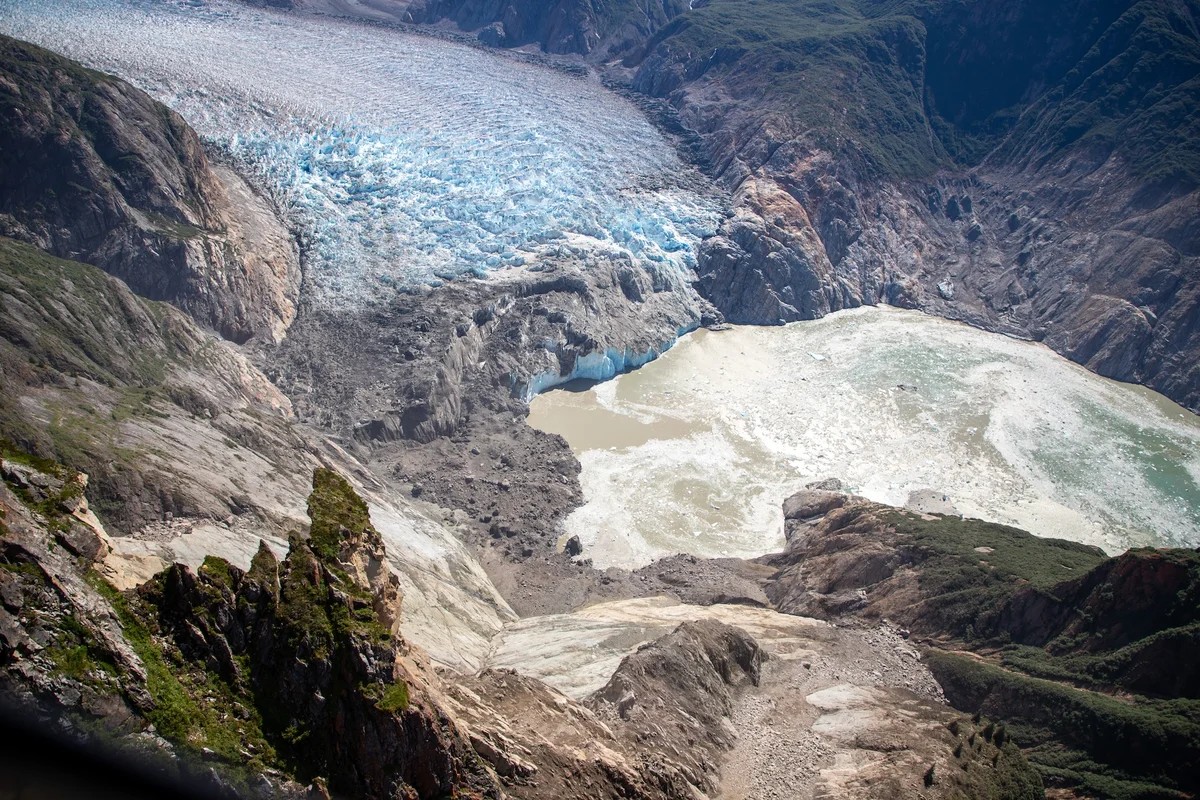
On the morning of August 10, 2025, Christine Smith woke up on her 65-foot wooden boat, the David B, anchored in an inlet along southeast Alaska’s rugged coast. She and her husband had been forced to delay their planned entry into Tracy Arm—a dramatic fjord southeast of Juneau—due to inclement weather. As the ship’s naturalist and chef, Smith prepared breakfast while noting the foggy conditions in her log. Her husband, the captain, suddenly interrupted her routine with a chilling question: “Have you ever seen this before?”
Outside, water was behaving erratically. It foamed over a nearby sandbar and surged repeatedly over large shoreline rocks before retreating. The tide should have been falling. Perplexed, Smith texted Jackie Caplan-Auerbach, a seismologist at Western Washington University, asking if these odd movements could signal a nearby landslide.
Caplan-Auerbach and other scientists later confirmed that Smith’s intuition was correct. Had the David B entered Tracy Arm as scheduled, the crew and passengers would have been killed. At approximately 5:30 A.M. Alaska Time, the north wall of the fjord collapsed just in front of the retreating South Sawyer Glacier, generating a 1,500-foot tsunami. A wall of water 300 feet high would have struck the boat with lethal force.
This near-miss event underscores a growing threat to ships and coastal communities as retreating glaciers destabilize landscapes. However, new research published in Science by Caplan-Auerbach and colleagues reveals that subtle seismic clues may offer early warnings for such disasters.
The Mechanics of Collapse
For two decades, climate warming has caused most of Alaska’s coastal glaciers to retreat, exposing steep, U-shaped fjord walls. Without the stabilizing weight of ice acting as a buttress, these rock walls are prone to collapse. Scientists have primarily focused on areas showing slow, visible signs of instability, such as Barry Arm in south-central Alaska, where a potential landslide could send a destructive tsunami to the town of Whittier within 20 minutes.
“We have our eyes on a very small number of potential slides, and there are obviously way, way more,” says Caplan-Auerbach.
The Tracy Arm event challenged this focused approach. Dan Shugar, a geomorphologist at the University of Calgary and lead author of the study, noted that there were no prior indications of slow collapse in Tracy Arm. “At Tracy Arm, there’s no indication that that was the case,” Shugar explained.
By analyzing seismic records and glacier observations, the research team identified a direct link between recent ice retreat and the landslide:
- Long-term Retreat: The South Sawyer Glacier has thinned and retreated over the last century.
- Accelerated Loss: Since 2000, episodes of shrinking have become more acute.
- Immediate Trigger: In the spring and summer of 2025, the ice retreated several hundred feet inland, exposing the rock face that ultimately collapsed just days later.
Kristen Cook, a geomorphologist at the University of Grenoble Alpes who was not involved in the study, described the connection as “quite a direct link.”
Using digital elevation models, researchers estimated that 2.26 billion cubic feet of earth collapsed, erasing about 500 feet of coastline. The resulting tsunami surged up the fjord walls to heights exceeding 1,500 feet. The energy released was so immense that it created a seismic “ringing” effect—similar to water sloshing in a bathtub—that was detectable globally for up to 36 hours.
Detecting the Undetectable
While the Tracy Arm collapse was sudden, it was not entirely silent. Caplan-Auerbach, who specializes in microseismic precursors to landslides, analyzed data from nearby stations after receiving Smith’s text.
The main collapse registered as a magnitude 5.4 earthquake. However, smaller seismic events occurred at least 24 hours prior, increasing exponentially in intensity six hours before the slide. This pattern matched other landslides Caplan-Auerbach has observed, suggesting these signals occur as rock slabs slip, jerk to a stop, and slip again.
“We’d love to identify precursors as early as possible, with the eventual goal of assessing where and when a landslide would occur,” Caplan-Auerbach said. “It’s possible that they occur prior to most slides, but we don’t have enough seismic data to detect them.”
Improving Early Warning Systems
Beyond precursors, the seismic signals generated during a landslide can be crucial for tsunami warnings. Unlike earthquakes, which produce impulsive ground vibrations, landslides generate signals that emerge slowly. This makes them difficult to detect in real time unless sufficient energy is released to be picked up by nearby stations.
Ezgi Karasözen, a research seismologist at the Alaska Earthquake Center and co-author of the study, has been testing a landslide detection algorithm for the Prince William Sound area. To date, the experimental system has detected 35 landslides in near real time.
“Ideally, we would have a notification within three to four minutes of something like this happening,” Karasözen said. This window could be lifesaving for communities like Whittier. However, the system does not cover Tracy Arm. When Karasözen attempted to pinpoint the source of the Tracy Arm event, the initial estimate was off by four miles.
The incident has spurred a push to improve hazard characterization. While adding more seismic stations in southeast Alaska would help, the harsh terrain makes this costly. Therefore, improving detection algorithms to better utilize existing networks is equally critical.
The Aftermath and Future Risks
A day after the landslide, Smith and her passengers entered Tracy Arm to witness the devastation. Beaches were stripped of vegetation, with icebergs stranded incongruously high on rocks. Mature hemlock and spruce trees had been “tumbled and pummeled,” their bark and branches sheared off. The South Sawyer Glacier, typically a brilliant blue, was coated in a layer of dust from the collapse.
The implications for tourism are significant. More than 20 vessels, including up to six large cruise ships carrying thousands of passengers, typically visit Tracy Arm and nearby Endicott Arm daily in the summer. Major cruise operators have announced they will avoid Tracy Arm for the upcoming tourist season.
Smith, who visited the area a few more times in the fall, does not plan to return this summer. She described feeling a loss of “trust” in environments she once considered safe, yet remains committed to sharing the region’s wonders.
“We all go to these beautiful places because we want to experience the beauty, and we want to be humbled by nature,” Smith said. “That scar that is there by the glacier is always going to be a reminder that this has happened there, and it can happen anywhere else.”
Conclusion
The Tracy Arm tsunami serves as a stark reminder that climate-driven glacier retreat is actively reshaping Alaska’s hazard landscape. While the event was sudden, emerging research suggests that subtle seismic signals may provide the early warnings needed to protect communities and maritime traffic in an increasingly unstable world.